
Vieux Carré
By Tennessee Williams
December 2007
Christ Church Neighborhood House
Williams’ early life is laid out in this inventive staging.
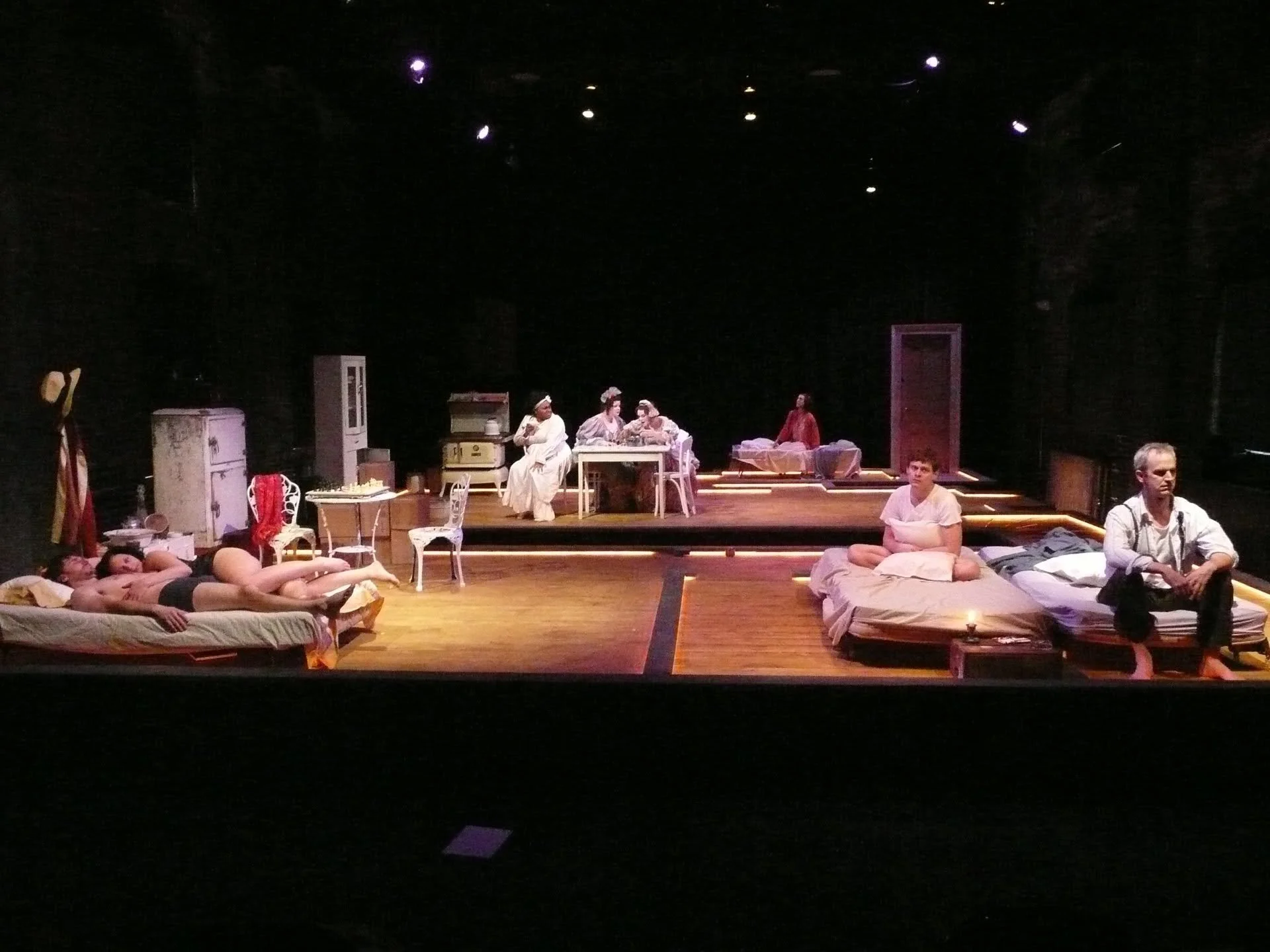
Vieux Carre (the French name for the New Orleans French Quarter) describes Tennessee’s early life as a young writer just coming out of the closet. Our production took the multistory home and flattened into a single plane, radically emphasizing the visceral sense of memory that surrounds this play. Our live Jazz band helped create an air thick with New Orleans flavor.
Creative Team
Lane Savadove … Director
Daniel T. Peterson … Musical Director
Dan Soule … Set Designer
Annie Canzano … Costume Designer
Matt Sharpe … Lighting Designer
Doug Smullens … Technical Director
Eric Snell … Stage Manager
Ralph Mullen … Production Manager
Cast
Doug Greene … The Writer
Leah Walton … Mrs. Wire
DaVine Randolph … Nurse
Andrew Borthwick-Leslie
Megan Snell (Hoke) … Jane
Andrew Borthwick-Leslie … Nightingale
Nathan Edmonson … Tye
Sarah Rachel Schol … Miss Carrie
Kristen Schier … Mary Maude
Robert DaPonte … Sky
About Tennessee Williams

Thomas Lanier Williams III (March 26, 1911 – February 25, 1983) was an American playwright and screenwriter. Along with contemporaries Eugene O'Neill and Arthur Miller, he is considered among the three foremost playwrights of 20th-century American drama.
Williams wrote his first play in 1930, but his work did not gain much traction until 1944 with the success of The Glass Menagerie. His next plays, including A Streetcar Named Desire (1947), Cat on a Hot Tin Roof (1955), Sweet Bird of Youth (1959), and The Night of the Iguana (1961), were also successful and widely acclaimed. With his later work, Williams attempted a new style that did not appeal as widely to audiences. His drama A Streetcar Named Desire is often numbered on short lists of the finest American plays of the 20th century alongside Eugene O'Neill's Long Day's Journey into Night and Arthur Miller's Death of a Salesman.
Much of Williams's work were adapted to film. He also wrote short stories, poetry, essays, and a volume of memoirs. In 1979, four years before his death, Williams was inducted into the American Theater Hall of Fame.