
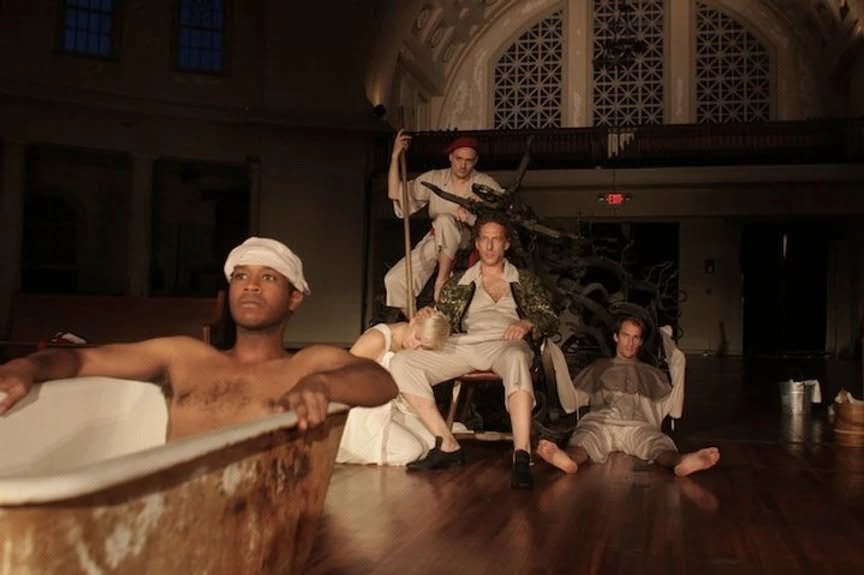
Marat/Sade
By Peter Weiss
September 2010
The Sanctuary at the Rotunda
A runaway hit of the 2010 Philadelphia Fringe Festival.
Our Theatre of Cruelty Season, based on the writings of Antonin Artaud, launched with this 1970s avant-garde classic. Staged in the remarkable Rotunda Sanctuary space in West Philly, The Persecution and Assassination of Jean-Paul Marat as Performed by the Inmates of the Asylum of Charenton Under the Direction of the Marquis de Sade (aka Marat/Sade) featured brand new music by Mathew Wright and performed live by the cast on toy piano, cello, mandolin, and accordion, Brenna Geffers' production was a wildly exuberant and visually "beautiful, sweeping staging" that set nihilism against hope.
Creative Team
Brenna Geffers … Director
Mathew Wright … Composer
Tony Hostetter … Scenic Design & Production Manager
Brian Strachan … Costume Designer
Matt Sharp … Lighting Designer
Joshua Wallace … Props Designer & Assistant Production Manager
Jacob Lyon Goddard … Technical Director
Michael Chittenden … Stage Manager
Cast
David Blatt … Marquis De Sade
Steve Wright … Jean-Paul Marat
Jered McLenigan … Herald
Megan Hoke … Corday
Sarah Schol … Simone
Ross Beschler … Roux
Andrew Clotworthy … Dupret
Cindy Spitko … Rossignal
Matt Wright … Curcuru
Griffin Stanton-Ameisen … Polpoch
Josh Totora … Kolkol
Joe Canuso … Coumier
Hank Curry … Voultaire
About Peter Weiss
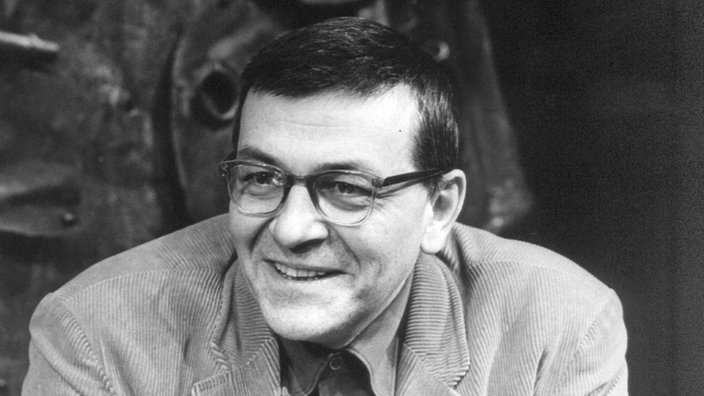
Peter Ulrich Weiss (8 November 1916 – 10 May 1982) was a German and Swedish writer, painter, graphic artist, and experimental filmmaker.
Weiss earned his reputation in the post-war German literary world as the proponent of an avant-garde, meticulously descriptive writing, as an exponent of autobiographical prose, and also as a politically engaged dramatist. He gained international success with Marat/Sade, the American production of which was awarded a Tony Award and its subsequent film adaptation directed by Peter Brook. His "Auschwitz Oratorium" The Investigation, served to broaden the debates over the so-called "Aufarbeitung der Vergangenheit" (or formerly) "Vergangenheitsbewältigung" or "politics of history". Weiss's magnum opus was The Aesthetics of Resistance, the latter of which has been called one of the "most important German-language work[s] of the 70s and 80s."